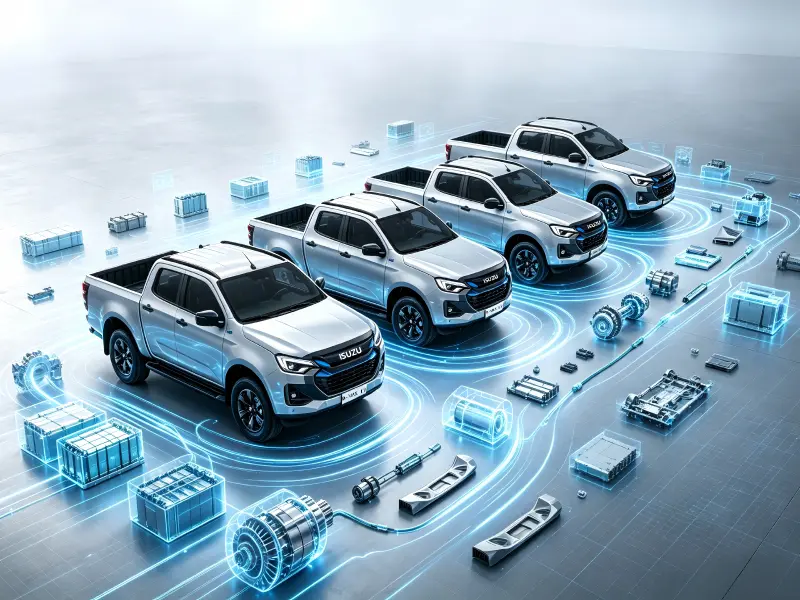
Isuzu Diesel and EV spare parts are gaining more attention as zero-emission regulations reshape commercial vehicle fleets across Southeast Asia, Latin America and many global urban zones, while Isuzu battery-electric light commercial models spring up.
Unlike traditional Isuzu diesel trucks powered by 4JJ1, 4HK1 and 4JB1 engines, electric Isuzu vehicles eliminate fuel injection systems, DPF, EGR and SCR emission components. Instead, high-voltage three-electric systems, e-drivetrains and thermal management parts become the core aftersales stock.
ISUZU’s Core Electric Commercial Vehicle Lineup
Isuzu prioritizes last-mile delivery, urban logistics and light-duty commercial scenarios for its EV portfolio. The mainstream models circulating for export include:
- ELF EV: The electric variant of the iconic N-series light truck, widely adopted for urban distribution fleets
- EVM100 / EV100: Compact electric trucks favored for cold chain and city cargo transport in emerging markets
- D-MAX EV: Electric pickup targeting Southeast Asian commercial and utility use
Note: BMS, OBC and CCS charging ports vary by regional specification and production batch. Spare parts for one market version are often not interchangeable with units sold in other territories.
ISUZU Diesel VS EV Parts Demand
For traditional Isuzu diesel trucks, most of the routine maintenance and inspection requirements depend on common emission parts, such as NOx sensors, DPF filters, EGR valves and urea system components. These diesel parts remain the most popular and stable selling products in the current aftermarket, many of which can also share the compatibility once matched to correct engine types
For the new Isuzu electric trucks, there are no engine exhaust parts. Instead, customs and local vehicle inspection rules now pay close attention to the safety of high-voltage electric parts.
Unlike regular diesel parts, EV battery and electric components need complete official certification documents. Without standard certification, goods may be detained at customs or cannot be used for local repairs. Therefore, it is vital to check suppliers’ certification support when choosing where to source EV parts.
High-Demand ISUZU EV Aftermarket Spare Parts List
High-turnover priority parts (Recommended for active inventory)
- E-axle assembly & reducer gears, reducer bearings & oil seals
- Battery management system (BMS), high-voltage contactors
- On-board charger (OBC), DC-DC converters
- Battery thermal system: Cooling plates, water pumps, control valves, temperature sensors, coolant expansion tank
- Vehicle control unit (VCU), CCS2 charging inlets, charging gun adapters
- Motor controller (MCU), drive motor stator & rotor
- Low-voltage auxiliary parts: 12V auxiliary battery, low voltage distribution box, main relay
Universal retained parts (Compatible with both diesel and EV models)
- Brake assemblies, brake pads, brake discs, brake calipers
- Suspension components: Shock absorbers, leaf springs, tie rod ends, ball joints
- Lamps, mirrors, wiper motors, wiper blades
- Cab body parts, door handles, window regulators, bumpers
- Tires, wheel hubs, wheel bearings
In-demand EV special parts
- Battery pack repair kits, battery cooling hoses
- Insulation monitoring modules, high voltage interlock switches
- Air conditioning electric compressor, PTC heater assembly
Isuzu’ electric commercial vehicle mushrooming brings new chances to the market, but diesel Isuzu trucks still occupy the majority of global fleets. A reliable supply-chain of diesel components will stay the core requirement for most distributors, while the EV spare parts have also drawn their attention. Moreover, we remain a primary supplier of full-range genuine & aftermarket Isuzu diesel spare parts for 4JB1, 4JJ1, 4HK1 and classic NPR/NQR/FTR series. Isuzu EV components are also available as an extended product line to support distributors expanding into the electric commercial vehicle market.
For more info, welcome to link www.nuomiparts.com
Share This Story, Choose Your Platform!
related posts
October 10, 2026
September 24, 2026
September 9, 2026